On the surface, 2025 looked like a massive rebound. It was the second-largest year for buyouts, with global deal value surging 44% to $1.175 trillion, heavily supported by an all-time high of $1.3 trillion in dry powder and decreasing debt costs.
However, those headline numbers mask a much more complex operational reality.
The liquidity backlog
The industry is currently sitting on approximately $3.8 trillion in unrealised value. The persistent bid-ask gap between buyers and sellers remains the most common breaking point for deals, which has pushed average holding periods to roughly 7 years.
A "Brutal" fundraising market
Because of this delayed liquidity, LPs are constrained by weak net distributions. There is currently about 2.5x more demand for capital from GPs than there is supply from LPs, leading to a 16% drop in buyout capital raised.
The New Maths of Value Creation: "12 is the new 5"
The most striking takeaway from the webinar was the rising cost of generating alpha. We have officially entered a paradigm where "12 is the new 5." To achieve a target 20% IRR over a standard holding period today, firms must drive approximately 12% annual EBITDA growth, a massive jump from the ~5% growth required just ten years ago.
So how do PE firms win in 2026?
The era of relying solely on financial structuring and market beta is over. Bain's data explicitly highlights that LPs are now prioritising GPs who can demonstrate a "repeatable alpha model" above almost all other criteria. Hitting these aggressive new targets requires a step change in underwriting and modern playbooks that heavily emphasise operational improvements and talent management.
A brilliant value creation plan on paper won't survive if the leadership team isn't equipped and aligned to execute it. Talent management starts at the very top, which is why treating board governance as a measurable system is becoming a highly practical, supporting lever for today's GPs.
While it is just one piece of a comprehensive value creation playbook, utilising a data-driven platform like BoardClic helps PE firms systematically address these new macro pressures:
Aligning for 12% growth
Squeesing 12% growth out of an asset requires zero friction at the top. Structured evaluations help ensure the "Troika" (Chair, CEO, and Deal Partner) stay completely aligned on strategy execution, catching early signs of misalignment before they slow down momentum.
Managing 7-Year holds
Over an extended 7-year holding period, a company will go through multiple distinct phases of transformation. Utilising data-driven skills matrices allows firms to continually monitor their board's competencies and proactively refresh the talent to match the current phase of the investment.
Proving the "Repeatable Model"
LPs want to see structural proof of success. Replacing anecdotal, "gut-instinct" board assessments with objective, portfolio-wide governance data is a concrete way GPs can prove they have a repeatable, proactive system for optimising portfolio leadership.
The hurdle for generating true alpha is higher than ever. Data-driven governance isn't a silver bullet, but pulling every available operational lever, including optimising the boardroom, is a critical foundation for executing the demanding playbooks that 2026 requires.

Ready to explore BoardClic?
Sign up to experience our free interactive demo today.

Blog
What is board business intelligence? A practical guide for boards
Blog
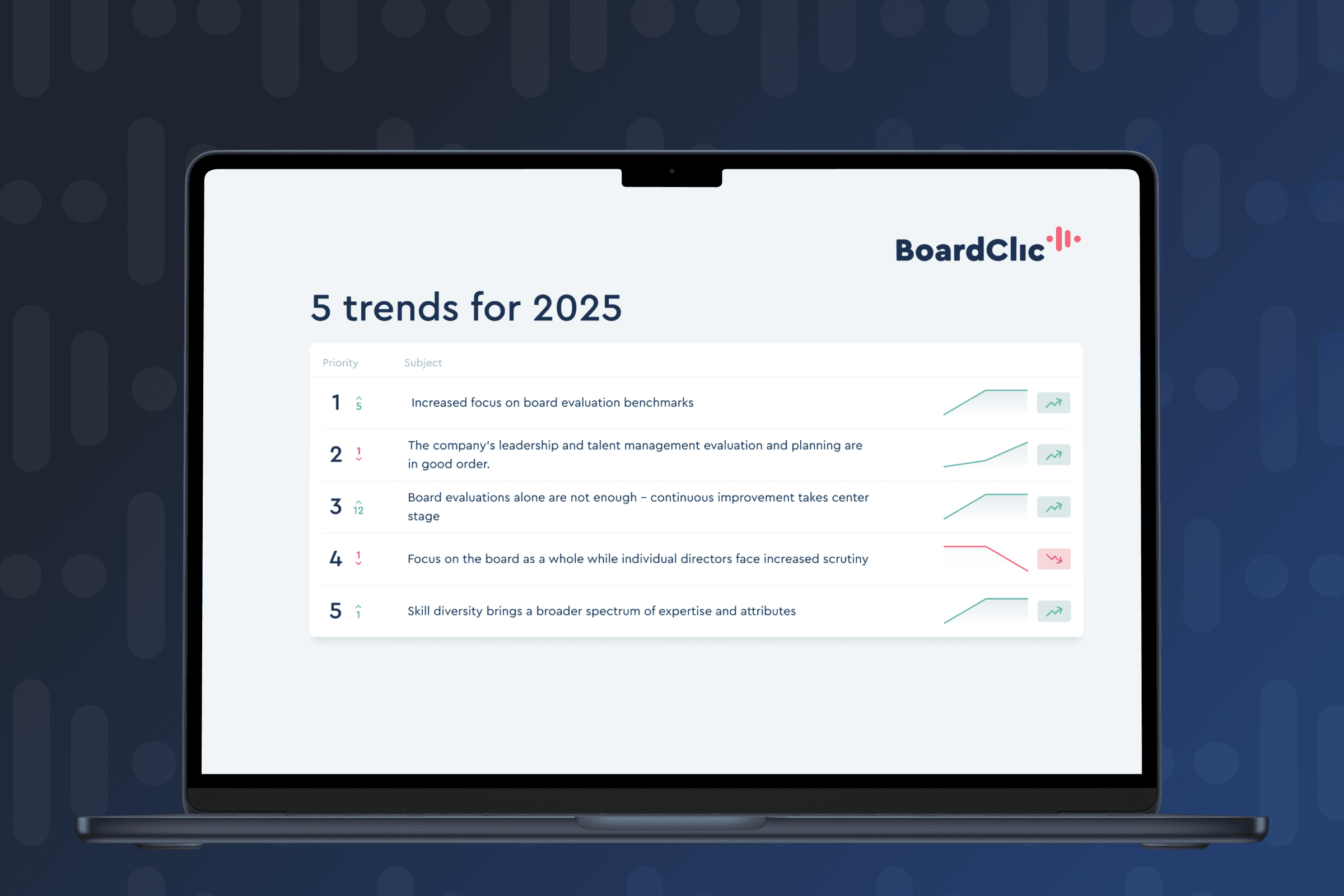
5 board governance trends reshaping what's expected of boards
Expectations on boards rarely go down. Owners, regulators and employees all want more insight into how the board works, not just what it decides. Organisations are getting more complex to oversee, and individual directors are more visible than they used to be. Here are five trends shaping board governance, and what they mean in practice.

Blog