
However, generating that performance has never been more complex. With high entry valuations and reduced reliance on leverage or multiple expansion, alpha must now come from operational improvement and transformation.
Across keynotes, panel debates, and roundtable discussions at the Private Capital Summit, a clear narrative emerged: the industry is shifting from financial engineering to operational execution.
Here are the five structural shifts shaping how private equity leaders must underwrite, operate, and exit in today's market.
The board is no longer a "hygiene exercise" but a performance variable
Historically, board composition in PE has been driven by tradition, internal capacity, or investor entitlement to seats. Today, that model is unsustainable.
A stark framing data point from BoardClic’s analysis of over 600 portfolio company board evaluations revealed a massive perception gap: while approximately 80% of board members believe they have the right skills to support the strategy, only about 32% of senior executives agree.
To close this execution gap, funds are radically changing their behavior. Boards must be intentionally designed and explicitly linked to the Value Creation Plan (VCP) from day one. The role of the Chair has also evolved; the traditional "Ceremonial" Chair who merely runs meetings is being replaced by the "Highly Engaged" Executive Chair who acts as a sparring partner to the CEO and bridges the sponsor and management.
Crucially, time allocation matters. Data shows that when a Chair holds three or more chair roles, portfolio performance begins to trail. Board capacity and overboarding must now be treated as a strict diligence factor. As funds scale, the legacy model of staffing internal investors on boards is giving way to building a bench of external industry specialists to drive better outcomes.
AI shifts from deal hype to operating model change
Artificial Intelligence is not just hype; it is a structural shift happening faster and at a greater scale than expected during the 2021 deal cycle. But the conversation has officially moved from demonstrations to deployment and operating model change.
For portfolio value creation, leading firms are adopting a "Front-Middle-Back" framing. Front-end marketing content generation and back-end call center automations are already working, while core middle-business functions require more bespoke solutions. GenAI is unlocking "classical" operational use cases, such as SKU rationalisation, where LLMs can cluster and rationalise hundreds of thousands of inconsistently described SKUs, a task previously considered intractable.
However, the real constraint to AI adoption is not the technology, it is culture and the operating model. AI programs only succeed when leaders champion the tools; if AI is pushed top-down without internal believers, it poisons adoption. As one panelist noted, a highly efficient weak business is still a weak business; AI amplifies capability, but it does not fix a broken strategy.
Exit readiness is "Institutional Muscle Memory," not a checklist
There is a dangerous disconnect in how exits are prepared. Sponsors define exit readiness broadly (equity story, strategic positioning, value creation track record), while CFOs often view it narrowly as a data room and financial due diligence checklist.
If exit preparation becomes merely a checklist, the strategy and the execution become disconnected, leading to undercooked equity stories and weak conviction during buyer due diligence. Buyers are increasingly scrutinising the evidence base, heavily discounting forward projections in favor of historical proof points, revenue quality (pricing vs. volume growth), and operating leverage.
Exit readiness should be the natural extension of value creation, not a separate 6-month sprint that exhausts the management team. Best-in-class funds are building this as "institutional muscle memory," integrating exit playbooks into their governance cadence and starting preparation 12 to 18 months in advance. Ultimately, the foundational discipline required to run the business well is exactly what makes for an easier exit.
ESG Matures into "EBITDA resilience"
The era of ESG as a public relations overlay is dead; it has matured into a core investment integration and resilience strategy. The terminology inside leading firms like Carlyle is shifting away from "ESG" toward "Sustainability," "Responsible Investing," and "EBITDA Resilience".
Sustainability must drive commercial value by avoiding losses and capturing revenue uplift.
Quantification is essential to build credibility with deal teams and identify repeatable value levers. For example, Carlyle analysed 200 portfolio companies and found that those with over 75% employee survey participation grew revenue significantly faster, validating their "Better Jobs Engine" initiative.
However, firms must balance quantification with materiality. The industry faces a massive structural friction point with LP reporting burdens, where GPs are flooded with questionnaires demanding broad data that may be entirely immaterial to a specific sector (e.g., asking a small-cap software business about hazardous waste). Looking forward, AI is proving to be a game-changer for sustainability teams, automating data architecture and moving ESG from static, unused dashboards into live workflows.
Talent and the Operating Partner as the central performance engine
More than half of private equity outperformance versus public markets is now attributed to operational and strategic factors. Consequently, the Operating Partner role has evolved from a peripheral "fixer" to a long-term strategic value architect.
Operating teams are now deeply embedded in the diligence phase, assessing organisational capability and execution risk before a deal even closes. Once acquired, the focus is on speed.
Because PE-backed businesses typically aim to double in scale within 3 to 5 years, the critical question is whether the current leadership can handle the next phase of growth. High-performing PE firms move early on leadership alignment, with most material leadership changes occurring in the first 12 to 18 months of ownership. Speed unlocks momentum, and leadership decisions simply cannot wait for financial underperformance to become obvious.
The Bottom Line In a volatile market where multiple expansion is a luxury of the past, success is dictated by execution discipline. The funds that will win the 2026 cycle are those that intentionally design their boards, embed AI to unlock operational bottlenecks, treat exit readiness as continuous muscle memory, quantify sustainability as EBITDA resilience, and place operating partners at the very center of their diligence and value creation engines.

Ready to explore BoardClic?
Sign up to experience our free interactive demo today.

Blog
What is board business intelligence? A practical guide for boards
Blog
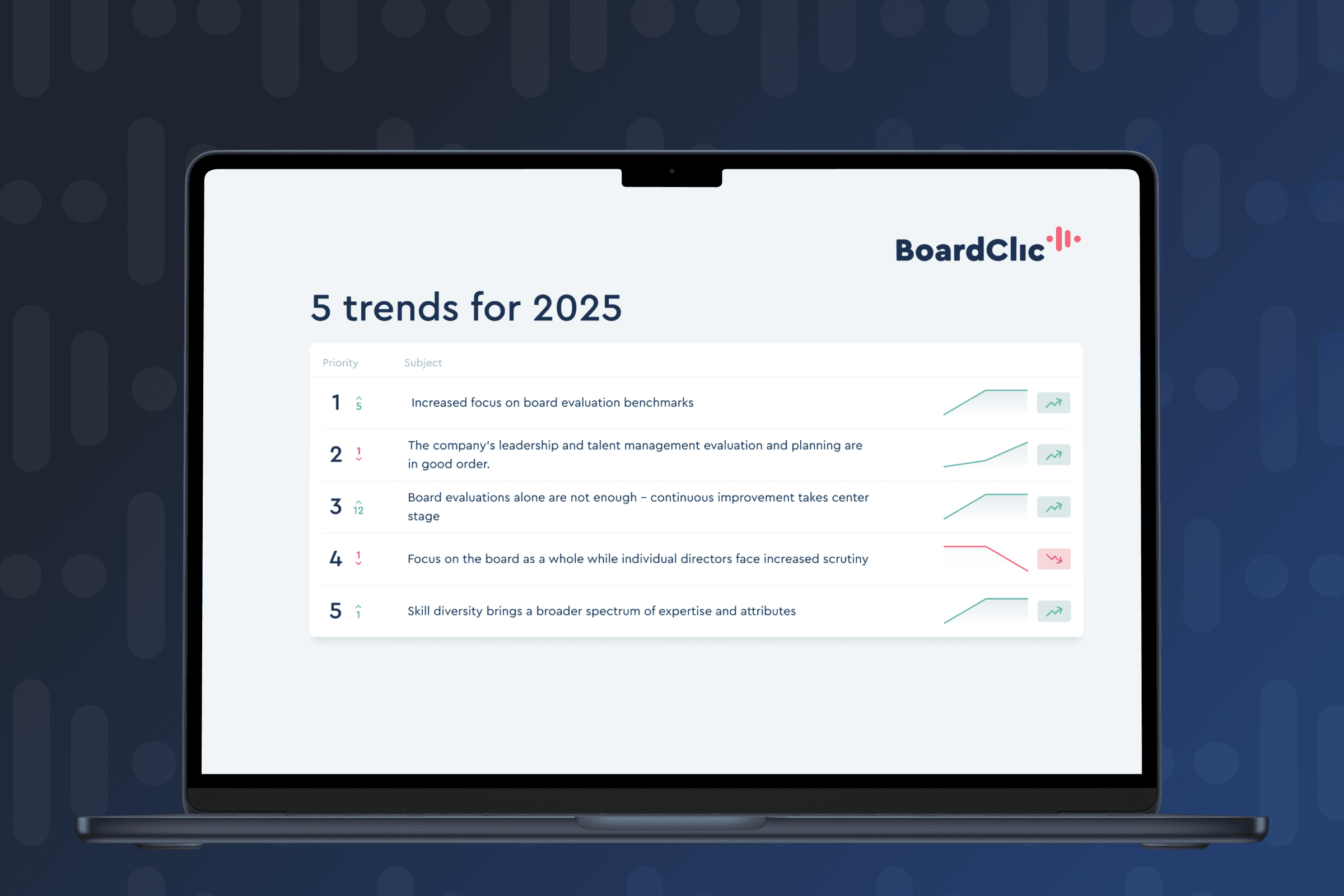
5 board governance trends reshaping what's expected of boards
Expectations on boards rarely go down. Owners, regulators and employees all want more insight into how the board works, not just what it decides. Organisations are getting more complex to oversee, and individual directors are more visible than they used to be. Here are five trends shaping board governance, and what they mean in practice.

Blog