
Board reviews are commonplace, although meaningful follow-through remains rare. While most boards conduct some form of self-assessment, fewer than one in ten translate the findings into a concrete plan. Trust between boards and management tends to be high, but trust alone does not strengthen governance or sharpen decision-making. ecoDa’s guidelines emphasise that self-evaluation should support continuous development, clearer accountability, and a more responsive board.
Drawing on BoardClic data from 2022 to 2025 and the practical insight of Malin Lombardi, our governance specialist, this report highlights five actions that help boards prepare for the expectations set out in the latest ecoDa Board Evaluation Guidelines. The guidance reflects patterns that appear across hundreds of evaluations, combined with Malin’s experience working directly with boards. Each section shows how effective boards tend to operate and how others can take steady steps towards healthier governance.
Forward-looking focus
What it means
Strong boards share a habit of looking ahead. They use meetings to explore what lies beyond the next quarter rather than revisit the last one. Strategy and foresight sit in the regular rhythm of governance. These boards make space for long-term value, resilience, and early risk spotting, supported by simple ways of identifying trends and testing strategy against them.
Why it matters
A forward-looking board understands how quickly an advantage can fade and helps the organisation invest before disruption arrives. The Chair keeps the discussion slightly uncomfortable, shifting focus from today’s KPIs to the forces that could reshape the market. European governance frameworks encourage this mindset. ecoDa highlights the need for boards to stay professionally equipped, responsive, and able to adapt as expectations and conditions evolve. The UK Corporate Governance Code also calls on boards to support long-term success and continued viability. High-performing boards put this into practice by tying major discussions to the strategic horizon and asking management to consider several possible paths rather than one fixed plan.
How to recognise it
Forward-focused boards show a few clear patterns. Their agendas reserve meaningful time for strategy, risk, and future opportunities, and they weave long-term themes such as sustainability, digital transition, and succession into ordinary discussion rather than treating them as separate items. BoardClic data shows that questions linked to strategic oversight score higher than any other governance area³, indicating that boards that engage seriously with future-oriented topics are seen as adding more value. You also see it in practices like horizon-scanning sessions, scenario work, or early warning dashboards that track leading indicators instead of waiting for results to catch up.
Regular board refreshment
What it means
Strong boards review their composition often and renew it with purpose. They keep a balance of skills, perspectives and independence that fits the organisation’s long-term goals. This usually involves adding directors with experience in areas such as digital change, sustainability or international growth, while planning smooth transitions as needs shift.
Why it matters
Thoughtful renewal helps the board ask sharper questions and challenge management constructively. Timely succession prevents skills gaps and keeps expertise aligned with strategy. A mix of new voices and seasoned directors also supports independence.
ecoDa stresses the value of self-evaluation and continuous development, noting that boards must ensure they have the right mix of competencies and remain responsive to changing expectations⁴. The UK Corporate Governance Code calls for regular reviews of independence and tenure⁵, and the EU Shareholder Rights Directive II requires clear nomination criteria⁶. Together they encourage ongoing, deliberate renewal.
How to recognise it
Boards that handle refreshment well keep an active skills matrix, track tenure patterns and plan transitions early. Turnover is steady rather than disruptive, and diversity is viewed as a source of wider thinking, not a compliance task. Minutes or disclosures often note that composition has been reviewed in light of strategy or emerging risks.
Continuous self-review
What it means
High-performing boards build reflection into their rhythm of work. Self-evaluation is treated as a steady discipline, not a box to tick, and takes place at three levels: the full board, its committees and individual directors. The results lead to real adjustments rather than being stored away until the next cycle.
ecoDa calls for evaluations that are purposeful, structured and able to drive clear improvement⁷. The UK Corporate Governance Code requires an annual assessment and, for larger companies, external facilitation at least every three years⁸. The aim is to encourage boards to examine themselves with the same care they apply to management.
Why it matters
Effectiveness changes over time. Skills, dynamics and priorities that once worked well may no longer fit a shifting environment. Continuous review helps boards spot issues early, whether unclear responsibilities, uneven participation or unproductive meeting habits.
Boards that act on findings show maturity and accountability. They learn faster, refine how information is used and improve the quality of debate. External reviews add an independent view, revealing patterns that may be hard to see from within, such as whether challenge feels safe or whether consensus is reached too quickly.
How to recognise it
You see the impact in the changes that follow. Agendas adjust, meeting structures evolve and action points are tracked and revisited. ecoDa notes that boards linking evaluations to a concrete improvement plan, with clear responsibility, sustain stronger effectiveness⁷. BoardClic data shows the same pattern: boards that act on review insights score higher on leadership tone and decision quality⁹.
Public reporting also offers clues. Many listed companies now outline not just that an evaluation took place but what it changed, such as refining committee reports or setting aside more time for forward-looking discussion. This signals to shareholders that the board takes its own performance seriously.
Informed and curious oversight
What it means
High-performing boards know that good oversight depends on curiosity as much as expertise. They do not rely solely on management reports but look for independent context, external views and direct exposure to the organisation.
ecoDa stresses that directors must stay well informed, devote time to understanding the business environment and keep their knowledge up to date¹⁰. The UK Corporate Governance Code asks directors to build a sound understanding of the company and its markets¹¹, while the EU Corporate Sustainability Reporting Directive expands the board’s duty to understand sustainability risks and opportunities¹². Together these expectations frame informed oversight as a core responsibility.
Why it matters
Directors who draw on varied information make stronger decisions. Broader context helps them challenge management intelligently and spot shifts earlier. It also reduces the blind spots that come from relying on a single narrative. Boards that cultivate curiosity signal a commitment to transparency and careful judgement, and discussions with management become more strategic when directors understand industry and regulatory trends.
How to recognise it
You see the signs in how the board works. Agendas include briefings from external experts or functional leaders. Directors reference industry benchmarks or recent studies, showing they have sought context beyond the board pack. Many boards build structured learning into the year, whether through short educational sessions, an annual development day or site visits that keep oversight grounded in operational reality.
Constructive challenge and support
What it means
The most effective boards hold two qualities in balance: challenge and support. They question management with rigour, then stand behind agreed decisions. The relationship is neither adversarial nor cosy, but marked by respect, open dialogue and disciplined debate.
The Chair is central to this balance. By drawing in quieter voices, keeping discussion evidence based and preventing dominance by any one participant, the Chair creates an environment where dissent feels safe and useful. Meetings become working sessions, not formal approvals.
Why it matters
Challenge is the board’s safeguard against complacency. Without it, assumptions harden and risks stay hidden. Yet challenge without support weakens confidence and execution. High-performing boards maintain a climate where management expects tough questions and clear accountability, yet trusts the board’s intent and values its input.
European frameworks support this balance. ecoDa links effective governance to independence, objectivity and a culture of accountability and continuous development¹³. The UK Corporate Governance Code requires that at least half the board be independent and that the Chair foster openness and constructive challenge¹⁴. In many European markets, separate Chair and CEO roles further help the board test management’s thinking while keeping relationships cooperative.
How to recognise it
A healthy challenge culture is visible in the tone of discussion. Meetings feature active questioning and careful listening. Directors test assumptions but avoid personal attack. Non executive only sessions are held regularly to address sensitive topics such as succession or CEO performance.
Minutes record key debates, not just outcomes, showing that disagreement is accepted. Strong Chairs invite views from all members and summarise areas of alignment before decisions are taken. Afterwards, the board speaks with one voice to management, so robust debate in the room leads to clear, consistent support outside it.
Closing thoughts
Boards that want to move beyond basic compliance need to act with intention. The habits outlined here are not dramatic, yet when applied steadily they distinguish high-performing boards from those that simply meet requirements. Prioritising forward-looking dialogue, renewing composition in line with strategy, holding themselves to account, staying curious, and encouraging open yet orderly debate all support a board that earns the confidence of management, shareholders and society.
The ecoDa guidelines point in the same direction. They underline the importance of self-evaluation, continuous development and a thoughtful mix of skills as foundations of effective governance. Drawing on Malin’s work with European boards and supported by BoardClic’s multi-year data, these habits offer a practical route for boards that want to prepare for those expectations and improve over time. Each board will shape its own path, but the direction is clear: performance grows through steady effort, reflective learning and strong stewardship from the Chair.
The best boards recognise that governance is never fixed. They take a moment after each meeting, each review and each year to ask a simple question: “What can we improve?” Boards that normalise that habit tend to find the answers they need and sustain high performance.
Sources
¹ ecoDa, Board Evaluation Recommendations (2019)
² UK Corporate Governance Code (2024)
³ BoardClic data 2022–2025
⁴ ecoDa, Board Evaluation Recommendations (2019)
⁵ UK Corporate Governance Code (2024)
⁶ EU Shareholder Rights Directive II
⁷ ecoDa, Board Evaluation Recommendations (2019)
⁸ UK Corporate Governance Code (2024)
¹⁰ ecoDa, Board Evaluation Recommendations (2019)
¹¹ UK Corporate Governance Code (2024)
¹² ecoDa, Board Evaluation Recommendations (2019)
¹³ UK Corporate Governance Code (2024)

Ready to explore BoardClic?
Sign up to experience our free interactive demo today.
Blog
What is board business intelligence? A practical guide for boards
Blog
5 board governance trends reshaping what's expected of boards
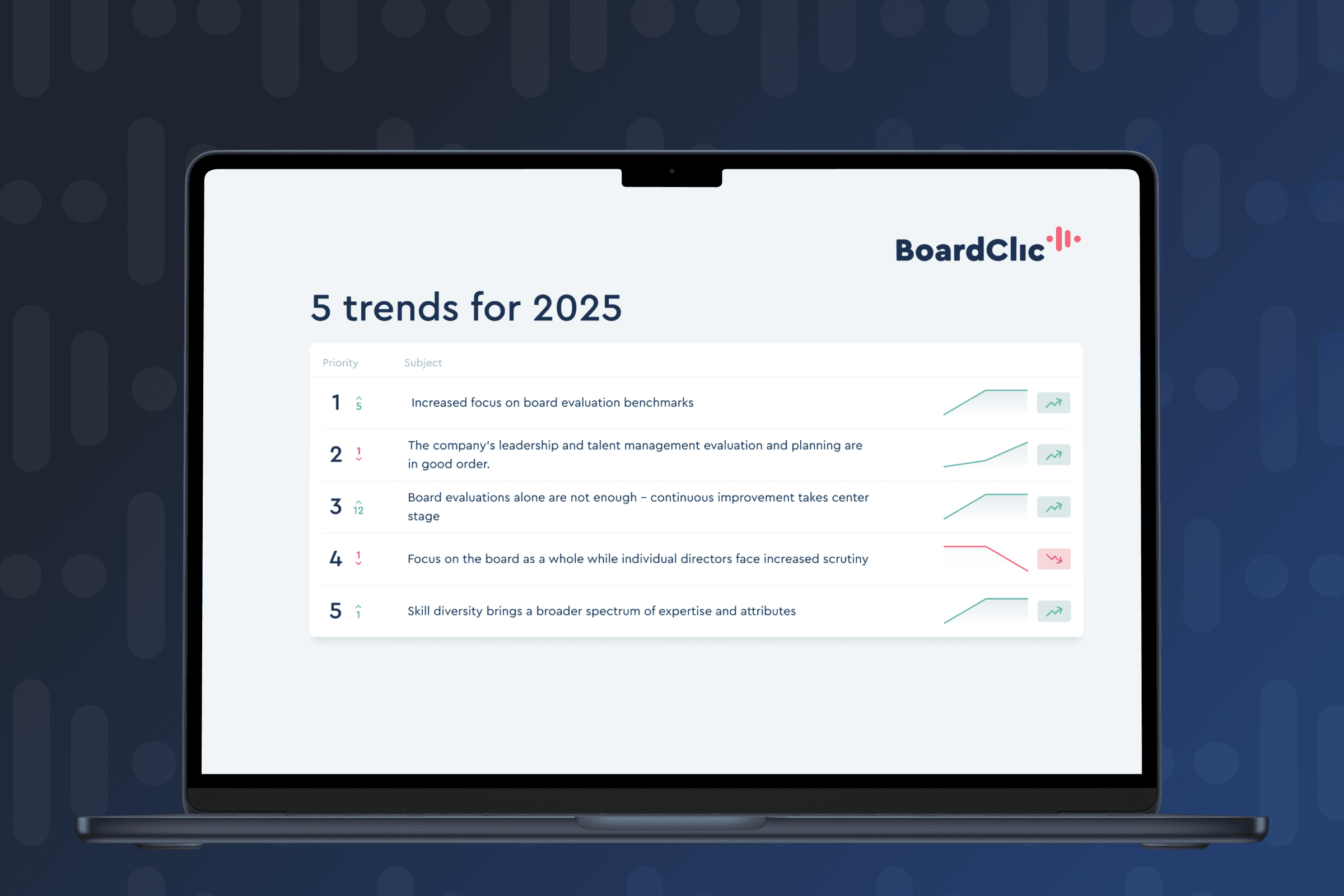
Expectations on boards rarely go down. Owners, regulators and employees all want more insight into how the board works, not just what it decides. Organisations are getting more complex to oversee, and individual directors are more visible than they used to be. Here are five trends shaping board governance, and what they mean in practice.

Blog