
What the Public Markets Are Telling Us
Grant Thornton analysed governance disclosures across 216 FTSE 350 companies, covering 267 governance data points per company. Their findings are difficult to ignore.
Companies with robust governance frameworks demonstrate:
43% greater operational efficiency
3.4x stronger cash flow
2x higher shareholder returns
In other words, governance quality correlates strongly with performance outcomes, not just compliance quality.
Yet the report also highlights a tension. While 69% of companies now claim full compliance with the UK Corporate Governance Code, only 3% fully meet the revised Code requirements in substance. Governance ambition is rising faster than governance capability.
This gap is not about intent. It is about execution.
"Private Equity Boards traditionally frame governance as a driver of momentum – ensuring oversight supports agility while safeguarding integrity and sustainability. Whilst it’s encouraging to see more FTSE 350 companies moving toward full compliance with the Code, listed company boards need to go further – building governance frameworks that don’t just protect but empower organisations to seize opportunities in a fast-changing world."
— Claire Fargeot, Head of Governance and Board Advisory at Grant Thornton UK.
Why This Matters for Private Equity
Private Equity firms are not constrained by public market reporting cycles or the same regulatory disclosure requirements. In theory, this should give them a material advantage: tighter ownership, clearer accountability and faster decision-making. Governance should be one of PE’s sharpest tools for accelerating strategy.
In practice, that advantage is often diluted. Governance in many PE-backed businesses remains deal-led rather than strategy-led. Board seats are frequently allocated based on who led the transaction or which investment partner has capacity, rather than on a deliberate assessment of the skills, experience and perspectives required to execute the investment thesis. As a result, boards can be structurally misaligned with the very strategy they are meant to oversee.
Reporting frameworks often reflect investor expectations more than board decision needs, and governance intensity tends to increase reactively when performance wobbles or risk materialises. Too rarely is governance designed upfront as an enabling system for growth, transformation and value creation from day one.
Viewed through this lens, Grant Thornton’s findings offer a useful mirror. Public market boards are now being forced to confront a reality that many PE investors instinctively understand but do not always act on: governance that exists primarily to protect value rarely creates it. Governance that is intentionally designed to support strategy, however, becomes a source of momentum rather than constraint.
From Governance as Control to Governance as Confidence
One of the most striking insights in the report is the emphasis on confidence. Governance works best when it gives boards confidence to act, rather than reasons to hesitate.
That is highly relevant for PE-backed companies navigating:
transformation programmes
add-on acquisition strategies
leadership change
technology and AI adoption
expansion into new markets
In each case, weak governance slows decisions because boards lack assurance. Strong governance accelerates decisions because risk is understood, owned and actively managed.
This is exactly what Grant Thornton mean by “guardrails to growth”.
"Technology disruption is reshaping growth models whilst economic shifts are redefining priorities and talent flows are evolving. Add geopolitical uncertainty and rising environmental and social expectations, and the message is clear: good governance is a catalyst for resilience, ethical leadership and bold decision-making."
— Claire Fargeot, Head of Governance and Board Advisory at Grant Thornton UK.
The Provision 29 Warning Sign – A Lesson for PE
Only 1% of FTSE companies currently meet the new internal controls declaration under Provision 29, which comes into force in 2026. The issue is not documentation. It is ownership.
Boards are being asked to stand behind the effectiveness of controls, not simply confirm that frameworks exist.
For PE investors, this is a useful warning. As scrutiny of private markets increases, LPs and regulators will increasingly expect:
clearer evidence of risk ownership
stronger internal control narratives
boards that can explain why they are comfortable, not just that they are
Waiting for regulation to force this conversation would be a mistake.
Where Private Equity Can Go Further Than Public Markets
The opportunity for PE is not to copy listed company governance, but to build on it.
Public markets are still constrained by legacy structures and disclosure norms. PE has the freedom to:
design boards around strategy, not tenure rules
align governance metrics directly to value creation plans
integrate culture, leadership and execution into governance discussions
refresh board capability dynamically as the investment thesis evolves
In this sense, governance becomes a portfolio-level operating system, not an individual company obligation.
A Reframe Worth Making
Grant Thornton’s report concludes that governance should be “a catalyst for resilience, ethical leadership and bold decision-making”.
For Private Equity, that framing is powerful. It moves governance out of the defensive bucket and into the value creation toolkit.
"Cyber risk and AI adoption are now mainstream issues, yet our research shows 55% of boards don’t identify AI as a principal risk, and 22% lack members with tech or data expertise. That will need to change quickly. Expect reporting in these areas to accelerate as organisations recognise their critical role in shaping sustainable success."
— Claire Fargeot, Head of Governance and Board Advisory at Grant Thornton UK.
The firms that win over the next cycle will not be those with outputs from productive governance. They will be the ones that can show how governance:
accelerates strategic execution
sharpens board decision-making
builds confidence to invest, acquire and transform faster than competitors
Governance is not the brake. But poor governance is.
The rest is momentum.
Additional reading:
Download: Corporate Governance Review 2025 | Grant Thornton
Is governance growing in the right places? | Grant Thornton

Ready to explore BoardClic?
Sign up to experience our free interactive demo today.
Blog
What is board business intelligence? A practical guide for boards
Blog
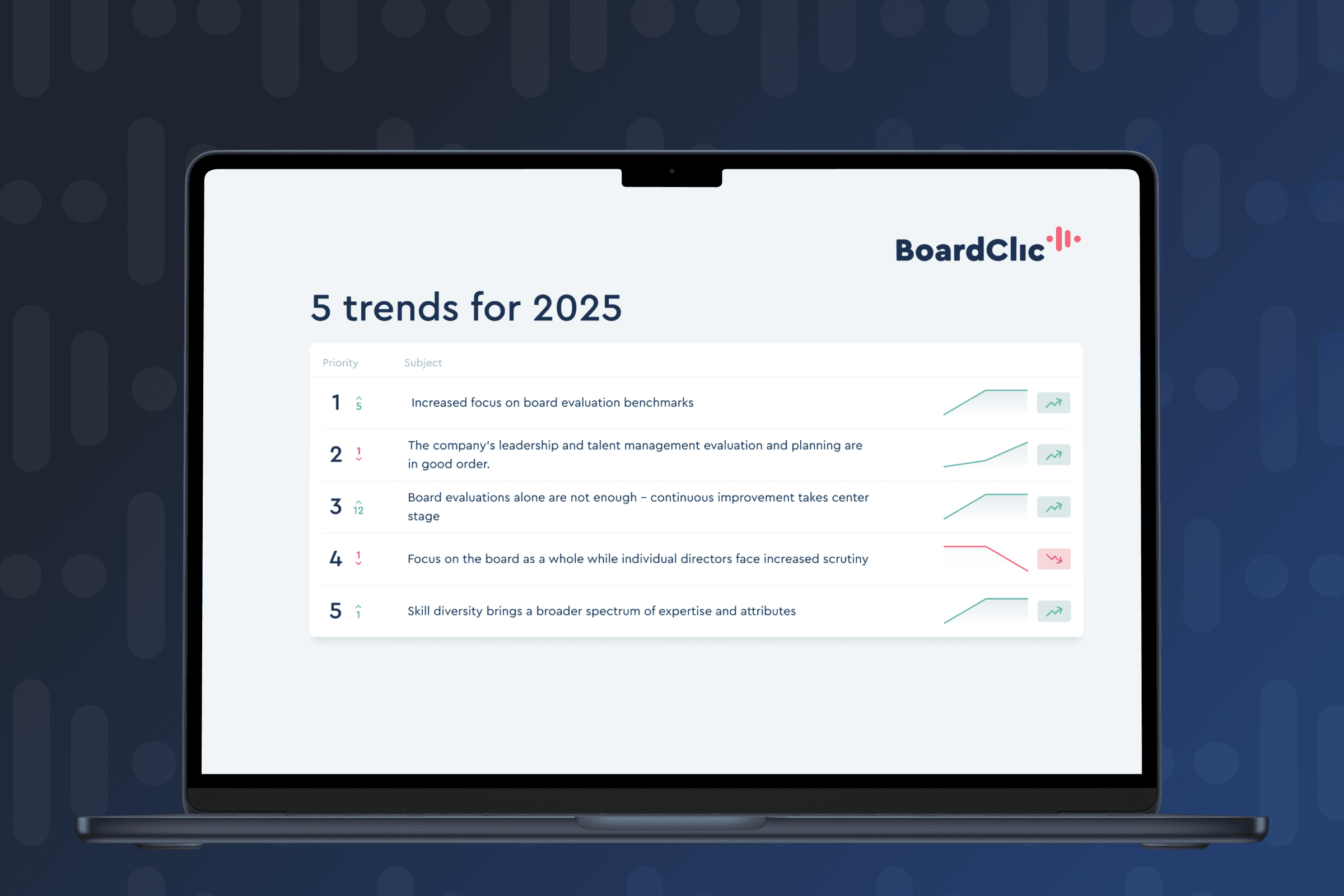
5 board governance trends reshaping what's expected of boards
Expectations on boards rarely go down. Owners, regulators and employees all want more insight into how the board works, not just what it decides. Organisations are getting more complex to oversee, and individual directors are more visible than they used to be. Here are five trends shaping board governance, and what they mean in practice.

Blog