What is board business intelligence? A practical guide for boards
In one of our evaluations, a board member described a problem many boards will recognise. He couldn't see the forest for the trees. Whenever his board dug into an issue, the discussion ended up in operational detail. (Read more about the forest problem.)
Most boards have more data about their company than ever: sales, margins, pipeline, risk registers. What they rarely have is data about themselves. That's the gap board business intelligence fills.
What is board business intelligence?
Board business intelligence is the structured collection and analysis of data about how a board works. It covers the board's effectiveness, skills, individual contributions and dynamics. The purpose is simple: to base decisions about the board's own development on facts instead of impressions.
Traditional business intelligence looks at the company. Board business intelligence turns the lens on the board. Read more about board business intelligence →
Why impressions aren't enough
Most boards believe they work well together. Often they're right. But a board's picture of itself is unreliable, because the people doing the judging are the same people being judged.
A chair may feel discussions are open, while two directors quietly think the agenda is too packed to raise anything difficult. Nobody is lying. They're just seeing different parts of the same meeting. Without structured data, gaps like that stay hidden until they cause a problem. Anonymous questionnaires and consistent questions make them visible.
What does board business intelligence measure?
The exact metrics vary, but most boards start with these areas:
Effectiveness. How well the board performs its core tasks, such as strategy, oversight and holding management to account.
Skills and composition. Which competencies the board has, and which are missing. A board skills matrix is the usual tool.
Individual contribution. How each director prepares, engages and adds value, often assessed through peer review.
Dynamics. How directors communicate, disagree and make decisions together.
Focus. How much board time goes to strategy versus operational follow-up. This is where the forest problem shows up in the data.
Benchmarks. How the board compares with other boards of similar size or industry.
The role of dashboards in board business intelligence
Data only helps if the board can use it in the room. That's what a dashboard is for.
A good board dashboard gathers the results in one place and shows how they develop over time, so the board can see whether last year's actions made a difference. It also shows where directors disagree. An average score of 3.8 can hide the fact that half the board answered 5 and the other half answered 2. That spread is often more interesting than the average itself.
The best dashboards are simple. A handful of metrics the board actually follows is worth more than fifty it glances at once a year.
Board business intelligence vs. a business intelligence director
The terms sound similar but refer to different things. A business intelligence director is an executive who leads a company's data and analytics work. They typically report to the CFO or CEO and are responsible for reporting on the business: sales, operations, customers.
Board business intelligence is owned by the board itself, usually driven by the chair or the company secretary. It isn't about the company's numbers. It's about how the board governs. A BI director can help the board get better reporting from the business, but they don't evaluate the board.
How to get started
Establish a baseline. Start with a structured board evaluation to see where the board stands today.
Choose a few metrics. Pick the three or four areas that matter most right now, and leave the rest for later.
Follow up during the year. Short check-ins between evaluations show whether changes are working.
Compare with others. Once you have your own baseline, benchmarks put the results in context.

Ready to explore BoardClic?
Sign up to experience our free interactive demo today.
Blog
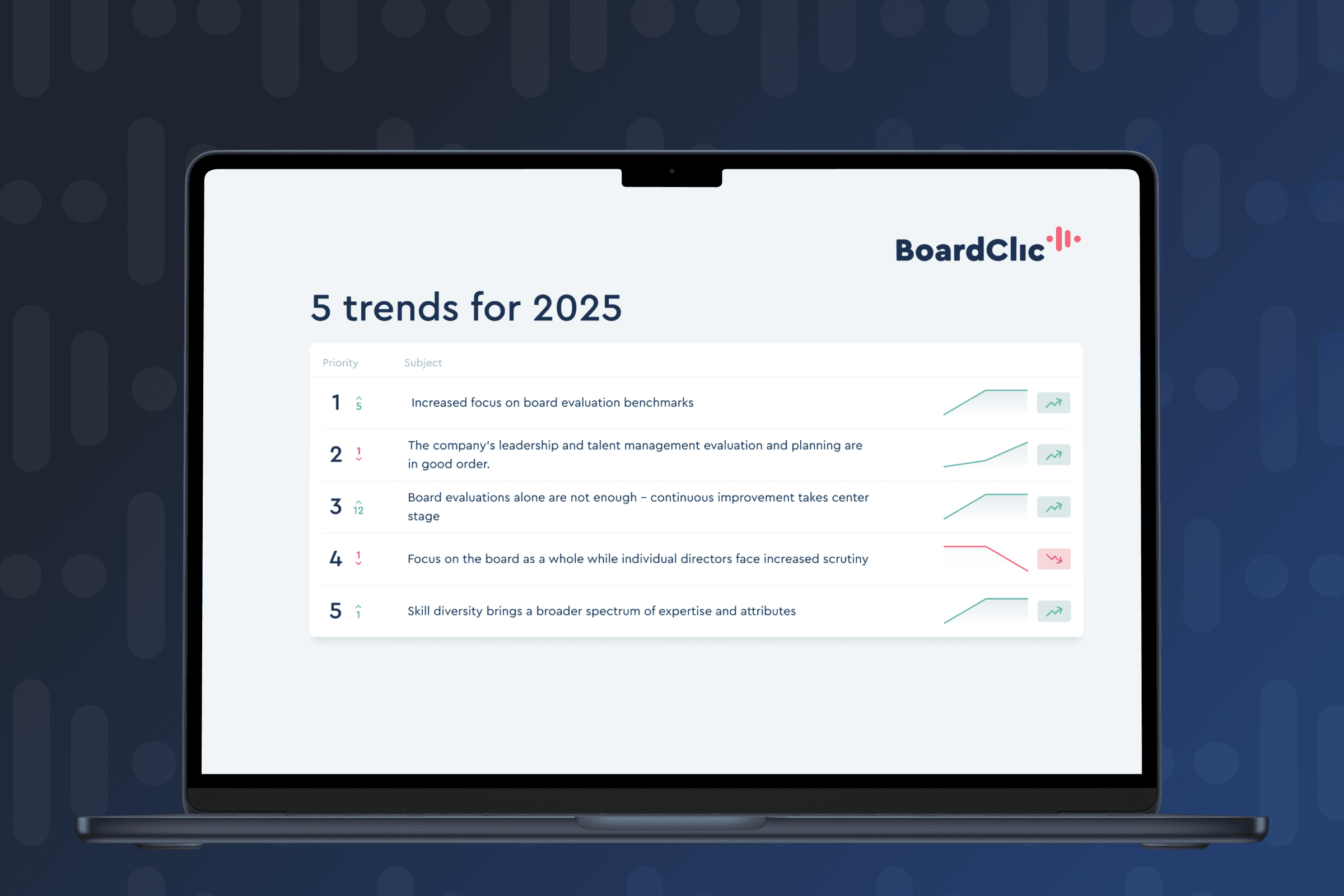
5 board governance trends reshaping what's expected of boards
Expectations on boards rarely go down. Owners, regulators and employees all want more insight into how the board works, not just what it decides. Organisations are getting more complex to oversee, and individual directors are more visible than they used to be. Here are five trends shaping board governance, and what they mean in practice.

Blog
The forest problem is a reporting problem
Looking into our data, we found one comment saying most, if not all, of what seems to be a challenge for many boards today: the board member stated that he couldn't see the forest for trees. Apparently, most of the time when his board went deeper into something, the focus was operational.
Blog