
According to Aston Martin Lagonda Annual Reports and Accounts 2022 (page 108), the benefit of using BoardClic “was that it enabled the data to be broken down between Executive Directors, Independent Non-executive Directors and Shareholder Representative Directors so that alignment between the three groups of directors could be assessed. It also enabled the results to be benchmarked against the results of other FTSE companies. The conclusions of the evaluation were very positive, concluding that the Board is highly effective and there is general alignment between the views of the Shareholder Representative Directors, Independent Directors and Executive Directors.”
Aston Martin’s vision is to be the world’s most desirable, ultra-luxury British brand, creating the most exquisitely addictive performance cars. Founded in 1913 by Lionel Martin and Robert Bamford, Aston Martin is acknowledged as an iconic global brand synonymous with style, luxury, performance and exclusivity. Based in Gaydon, England, Aston Martin Lagonda designs, creates and exports cars which are sold in 55 countries around the world.

Ready to explore BoardClic?
Sign up to experience our free interactive demo today.

Blog
What is board business intelligence? A practical guide for boards
Blog
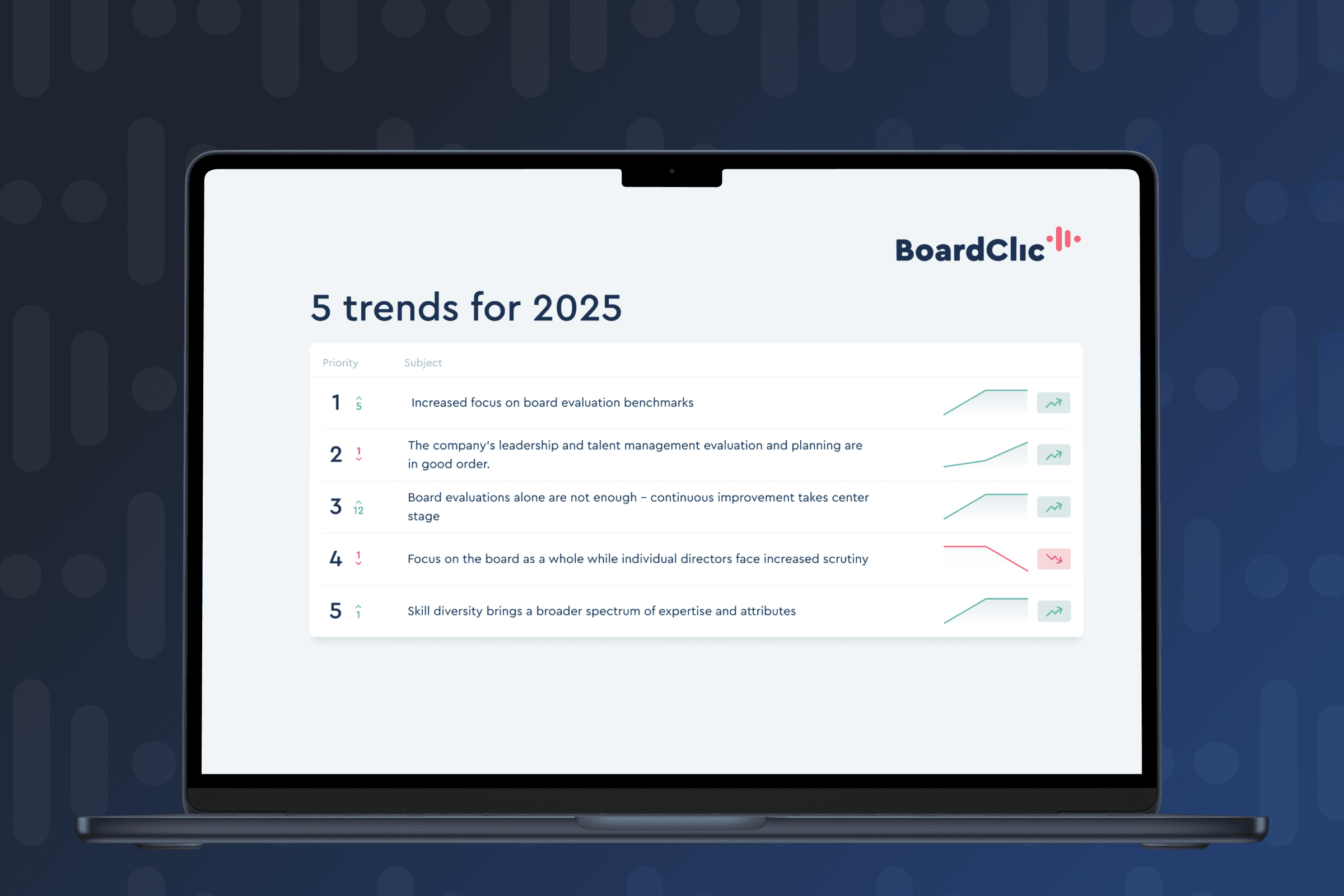
5 board governance trends reshaping what's expected of boards
Expectations on boards rarely go down. Owners, regulators and employees all want more insight into how the board works, not just what it decides. Organisations are getting more complex to oversee, and individual directors are more visible than they used to be. Here are five trends shaping board governance, and what they mean in practice.

Blog